Concrete is tough, but in Colorado Springs, the ground beneath it rarely stays put. Our crews constantly battle the notorious Pierre Shale and Bentonite clay found throughout the Pikes Peak region. These expansive soils act like a sponge, swelling when wet and shrinking when dry, which leaves driveways and sidewalks with zero support.
You have likely seen the result: a slab that looked perfect last summer now sits an inch lower than the garage floor. The real frustration isn’t just the look; it’s knowing that a single bad winter can turn a minor nuisance into a major construction project. From what we see in the field, catching these shifts early is the only way to avoid the massive expense of a full tear-out.
In this guide, we will break down the seven clear indicators that your soil is moving and explain exactly how to fix it before the damage spreads.
1. Uneven or Raised Surfaces
The most immediate red flag is a sudden change in height between two sections of concrete. You might feel this before you see it, usually as a jarring “step” when walking from your driveway to your front walk. In our industry, we consider any abrupt height difference greater than a quarter-inch to be a mechanical failure of the sub-grade.
This movement is almost always caused by the clay soil beneath your slab drying out and shrinking, leaving a void. The concrete, having nothing to hold it up, eventually snaps and settles.
Pro Tip: Take a standard 4-foot level and place it across the joint. If you can slide your pinky finger under one end of the level, that slab has settled enough to require attention. Ignoring this now usually leads to the slab cracking in half as gravity takes over.
2. Trip Hazards at Slab Joints
Uneven concrete is more than an eyesore; it is a legal liability. In Colorado, property owners are responsible for the maintenance and safety of sidewalks adjacent to their homes. Under the Colorado Premises Liability Act (§ 13-21-115), you could be held liable if a delivery driver, neighbor, or guest trips and injures themselves on your property.
We often hear from homeowners who received a warning letter from their insurance company after a drive-by inspection. Insurers are increasingly strict about this. They know that falls are a leading cause of homeowner claims.
If you have a vertical edge of 1/4 inch or higher, it meets the ADA definition of a trip hazard. Concrete leveling is the standard solution here because it removes the liability in a matter of hours, rather than the days required for replacement. For public sidewalks and walkways, our sidewalk leveling service is specifically designed to address ADA compliance issues quickly.
3. Water Pooling on Concrete Surfaces
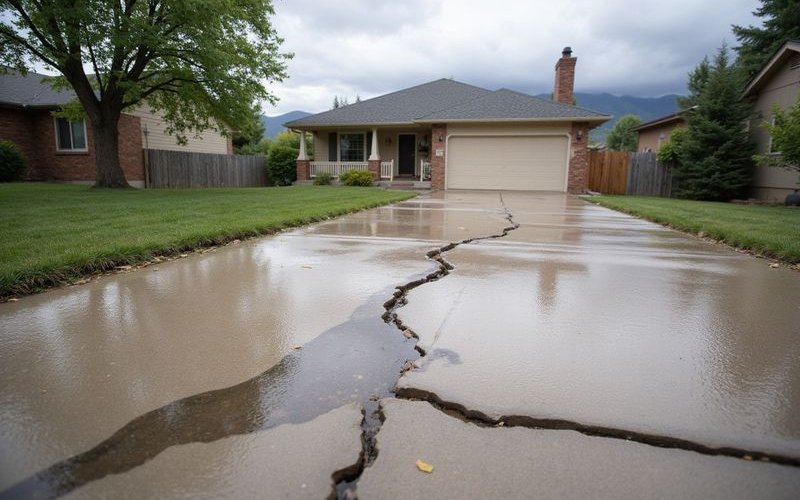
Properly poured concrete should always have a slope of at least 1% (about 1/8 inch per foot) to drain water away from your home. If you see “birdbaths” or puddles forming in the middle of your driveway after a rainstorm, that slab has settled backward.
This is critical to address in Colorado Springs because of our freeze-thaw cycle. When that standing water freezes overnight, it expands. This expansion acts like a hydraulic jack, forcing small cracks to open wider and causing the surface to spall (chip away).
Why this matters:
- Foundation Risk: Water pooling near your home can seep into your basement or crawlspace.
- Ice Hazards: Winter puddles turn into invisible black ice sheets on your walkway.
- Accelerated Damage: Concrete saturated with water deteriorates 50% faster during freezing temps.
If water pooling is concentrated on your driveway, our driveway leveling service can restore proper drainage slope in just a few hours.
4. Gaps Between Concrete and Structures
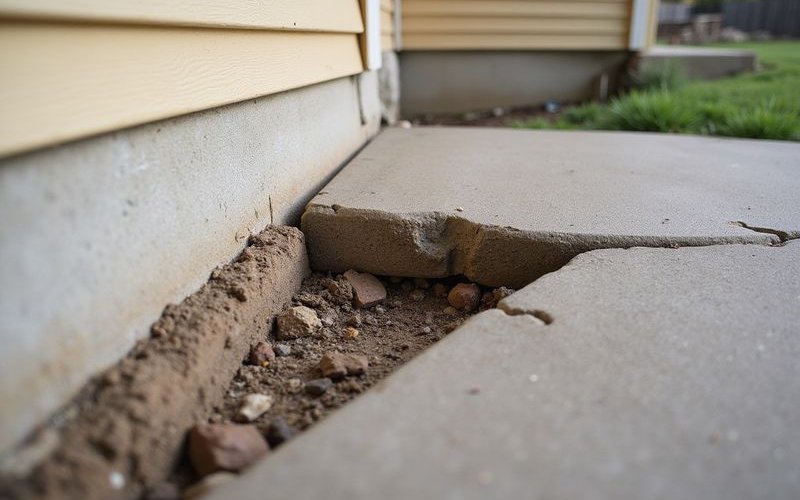
Take a walk around the perimeter of your house. Look closely where your patio or driveway meets the foundation, garage floor, or porch steps. You might see a gap where the sealant has torn away, or where the slab has physically pulled back from the wall.
These gaps are the “entry wound” for future damage. They allow water, snowmelt, and pests to get under your slab. Once water gets under there, it washes away even more soil, creating a feedback loop that speeds up the settling.
The Fix: For gaps wider than half an inch, do not just fill them with caulk. You need to insert a “backer rod” (a foam rope) first to give the sealant something to rest against. We strictly recommend using a polyurethane sealant rather than silicone, as polyurethane remains flexible enough to handle our temperature swings without peeling. Our professional concrete caulking service handles all joint sealing and crack repair with commercial-grade materials.
5. Cracking Patterns in the Concrete
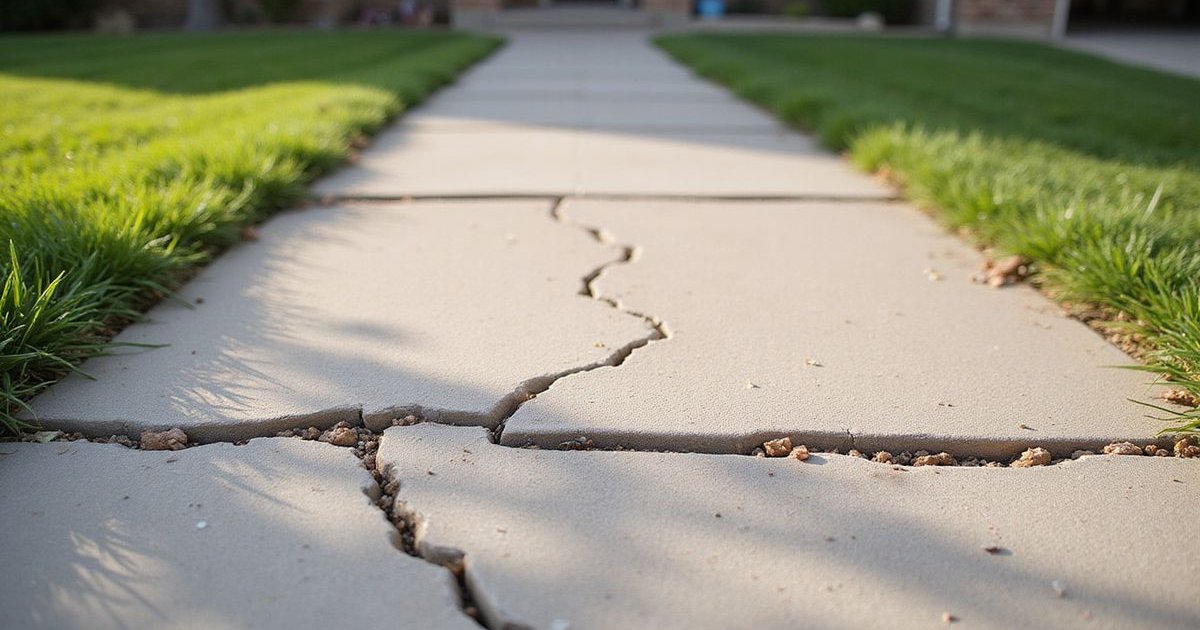
Not all cracks are created equal. Hairline cracks (less than 1/8 inch wide) are often just cosmetic issues from the original curing process. However, specific types of cracks tell us that the slab is physically moving.
Watch out for these structural indicators:
- Offset Cracks: If you run your hand over the crack and one side is higher than the other, the sub-soil has failed.
- Widening Cracks: A crack that grows from hairline to 3/16 inch (the width of a matchstick) over a season indicates active soil erosion.
- Corner Breaks: When a triangular piece of concrete snaps off at the corner of a slab, it usually means the center of the slab is floating on a void.
6. Doors and Windows That Stick
This is the sign most homeowners miss because it seems unrelated to concrete. If your front porch or garage slab settles significantly, it can pull on the framing of your house. This tension distorts the door jambs and window frames directly above the settling area.
If you have a door that suddenly sticks in the upper corner, or a deadbolt that no longer lines up with the strike plate, check the concrete below it. This is called “differential settlement.” It means your home and your porch are moving in opposite directions. leveling the slab often releases this tension, allowing the door to swing freely again instantly.
7. Visible Soil Erosion Around Slabs
In many Colorado Springs neighborhoods, especially those built on the foothills or slopes, drainage is a constant challenge. Inspect the edges of your driveway and sidewalks. If you see a gap between the grass and the concrete, or if you can see the jagged underside of the slab, you have a washout problem.
This often happens when downspouts dump water too close to the concrete. The water burrows under the slab, carving out tunnels in the soil.
Immediate Action Item: Install downspout extensions that carry roof water at least 4 to 6 feet away from your concrete. If you can see the underside of your slab, the support is already gone, and the concrete is bridging a void. It is only a matter of time before the weight of a vehicle snaps it.
The Solution: Leveling vs. Replacement
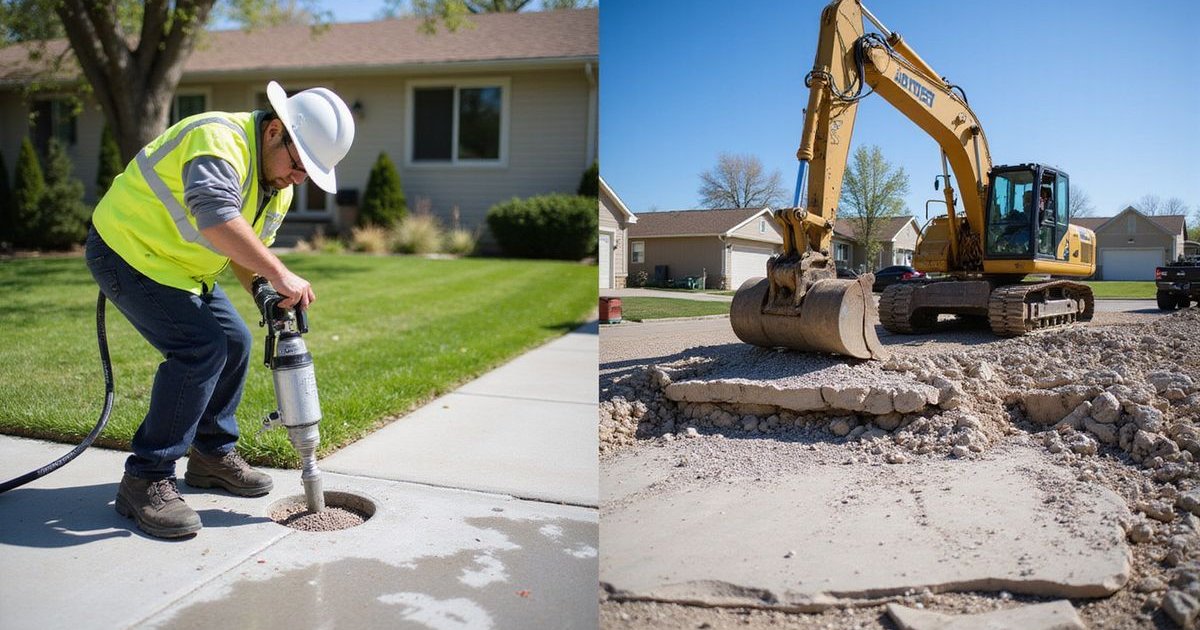
If you spot these issues, you generally have two choices: tear it out or level it. Full replacement in the Colorado Springs area currently runs between $9 and $18 per square foot, depending on access and reinforcement needs. Leveling is typically 50% to 70% cheaper.
We use modern leveling techniques to inject material beneath the slab, filling the voids and lifting the concrete back to its original grade. For a deeper dive into these options, see our guide on mudjacking vs foam leveling. Here is how the two main methods compare:
Comparison: Mudjacking vs. Polyjacking
| Feature | Mudjacking | Polyjacking (Polyurethane) |
|---|---|---|
| Material | Sand, water, and cement slurry | High-density foam |
| Drill Hole Size | Large (1-2 inches) | Tiny (5/8 inch) |
| Cure Time | 24 - 48 hours | 15 - 30 minutes |
| Weight | Heavy (adds burden to soil) | Lightweight (surroundings stay stable) |
| Est. Cost | ~$4 - $6 per sq. ft. | ~$5 - $8 per sq. ft. |
Get a Free Estimate Today
Waiting rarely saves money when it comes to foundation and flatwork issues. The freeze-thaw cycles we experience will only widen those cracks and drop those slabs further by next spring.
At Colorado Springs Leveling, we know the Pikes Peak geology better than anyone. We can tell you exactly what is happening under your driveway and give you an honest assessment of whether it can be saved. If you have seen any of these seven signs, contact us today for a free estimate. Let’s get your property safe and level again.